Google Business Profile Rankings Dropped Suddenly? Here’s What to Do
Published 10 October 2026
You have been getting calls from Google for months. Then, without any obvious reason, the enquiries start to dry up. You check Google Maps and find that your business is no longer appearing where it used to.
If you are a roofer, locksmith or blinds installer, this can quickly become a problem. Fewer people finding your business means fewer calls, fewer quote requests and potentially empty days in your diary.
Before changing anything, find out what has happened. A drop in Google Maps rankings does not necessarily mean your profile has been penalised. Your listing might have an issue, another business might be appearing above you, or your website might have lost visibility.
I would start with a few simple checks before spending money on SEO work or making changes to a profile that was working perfectly well a few weeks ago.
First, Find Out What Has Actually Dropped
There is a difference between losing rankings, receiving fewer calls and disappearing from Google Maps altogether.
Take a roofer in Leicester as an example. The business might still appear when someone searches for its name but no longer show near the top for "roof repairs Leicester".
A locksmith might still rank for "locksmith in Manchester" but struggle to appear for "emergency locksmith near me". A blinds installer might have similar rankings to last month but receive fewer website enquiries.
Each situation needs a different approach.
I would check five things first:
- Google Maps: Has the business moved down the results for its main services?
- Business profile: Does the listing still appear when you search for the exact business name?
- Calls and enquiries: Have calls, website visits or quote requests fallen?
- Website traffic: Are the pages for your main services getting fewer visitors from Google?
- Profile status: Has Google requested verification, rejected an edit or suspended the listing?
Write down what you find. If you know roughly when the decline started, that is useful too. You can then compare the figures with the period before the drop instead of relying on what you remember seeing in Google Maps.
1. Check That Your Business Profile Is Still Active
If your listing has disappeared completely, I would check its status before looking at competitors or changing the website.
Sign in to the Google account that manages your Business Profile. Open the profile in Google Search or Google Maps and look for notifications about verification, suspension or rejected changes.
If the profile has been suspended, read Google's explanation and check the relevant guidelines. You may need documents showing that the business is genuine and operates as described. Depending on the circumstances, these could include business registration documents, invoices or photographs of permanent business signage.
You can find the relevant guidance in Google's Business Profile appeals tool.
Do not create a second listing to replace the first one. If the original profile has a problem, a duplicate will not necessarily fix it.
There is also no point treating every ranking decline as a suspension. If customers can still find your listing by name and the profile is active, I would move on to checking the rankings and performance data.
2. Check Your Rankings in More Than One Location
I would not judge a ranking drop by searching once on my phone.
Google Maps results can change depending on where the person searching is located. Your business might appear prominently near your premises but much lower in another part of the town.
Choose three or four searches that bring in the right type of customer.
For a roofing business, I might check:
- Roofer in Leicester
- Roof repairs Leicester
- Flat roofing Leicester
For a locksmith, I would look at:
- Locksmith in Manchester
- Emergency locksmith Manchester
- Lock replacement Manchester
For a blinds installer, I might use:
- Blinds fitters in Birmingham
- Made-to-measure blinds Birmingham
- Blinds installation Birmingham
Check the same searches in comparable locations and record the results. If you use a local rank-tracking tool, a geographical grid can help show how visibility changes across your service area.
This is important because a business can rank well in one part of a town and poorly in another. A single search does not tell you what every potential customer sees.
If rankings have fallen across most of your service area, I would investigate the profile and website more closely. If the decline is limited to a few locations or search terms, I would look at the businesses now appearing above you and compare their relevance to those searches.
3. Think About What Changed Before the Drop
Did you recently change your business name, primary category, address or service area? Perhaps you moved premises, changed your telephone number or transferred the profile to another Google account.
Make a note of any changes that happened shortly before the decline.
An edit does not automatically cause a ranking penalty, but it is worth checking whether the information is still correct.
Business name
Your profile name should be the name your business actually uses. If you are called ABC Roofing Ltd, adding a list of towns and services to the name just to rank for more searches can breach Google's guidelines.
I would keep the name accurate rather than trying to improve rankings by adding keywords.
Primary category
Check that your main category describes the business properly. A roofing contractor, locksmith and blinds retailer provide different services, so the category needs to reflect what the business actually does.
If the category is already right, I would leave it alone. Changing it repeatedly without a clear reason makes it harder to work out what is helping and what is not.
Address and service area
If you travel to customers rather than serving them at your premises, make sure your profile reflects that arrangement.
For example, a locksmith who visits customers at their homes should not display a residential address as a public shop address if customers are not served there. Check Google's rules for service-area businesses before changing these settings.
Phone number and website
Test the telephone number and open the website link from your profile. If either has changed recently, make sure customers are reaching the correct business.
If everything checks out, do not keep editing the profile simply because the rankings are lower. Move on to the next checks.
4. Look at Your Profile Performance
Your Google Business Profile performance data can help you understand whether fewer people are finding the business or whether fewer of those people are getting in touch.
I would compare the last 28 days with the previous 28 days. If the business has enough historical data, I would also compare the same period last year.
Look at the available figures for searches, profile views, calls, website clicks and direction requests.
Suppose a roofing company has seen both profile views and calls fall. That gives me a reason to investigate whether fewer people are finding the listing.
If profile views are broadly unchanged but calls have dropped, I would look at other factors. Perhaps demand has slowed, opening hours are incorrect, customers are choosing competitors, or the website is not making it easy to request a quote.
The same applies to other trades. Blinds enquiries can change with home improvement demand, while locksmiths may see different patterns in emergency call-outs and planned lock replacements.
A quieter month does not automatically mean your SEO has stopped working. The figures help show where the problem might be.
5. Compare Your Business With the Ones Ranking Above You
If your profile is active and the information is correct, I would look at the businesses now appearing above yours.
Search for your main services and compare a few of the leading local results.
Check whether their categories match the search, whether they provide the relevant services, how customers describe their experience in reviews, and whether their websites explain their services clearly.
For example, a roofer might have a general homepage but no useful information about roof repairs, flat roofing or roof replacement. Another local business might have clear service pages that answer the questions homeowners are asking.
A locksmith may need to explain its residential and commercial services clearly, while a blinds installer should make it easy for customers to understand which blinds are available and whether fitting is included.
Reviews are worth checking too, but I would not assume the business with the highest review count must rank first. Google considers several factors, including relevance, distance and prominence.
The aim is to find gaps you can realistically address. Do not copy every competitor's approach, and do not report another business simply because it ranks above you.
6. Check Whether Your Website Has Lost Visibility
Sometimes the profile is still active, but the website has problems that deserve attention.
Think about any recent website changes. Have you redesigned the site, changed the domain, removed service pages or altered URLs? Have enquiries fallen since those changes were made?
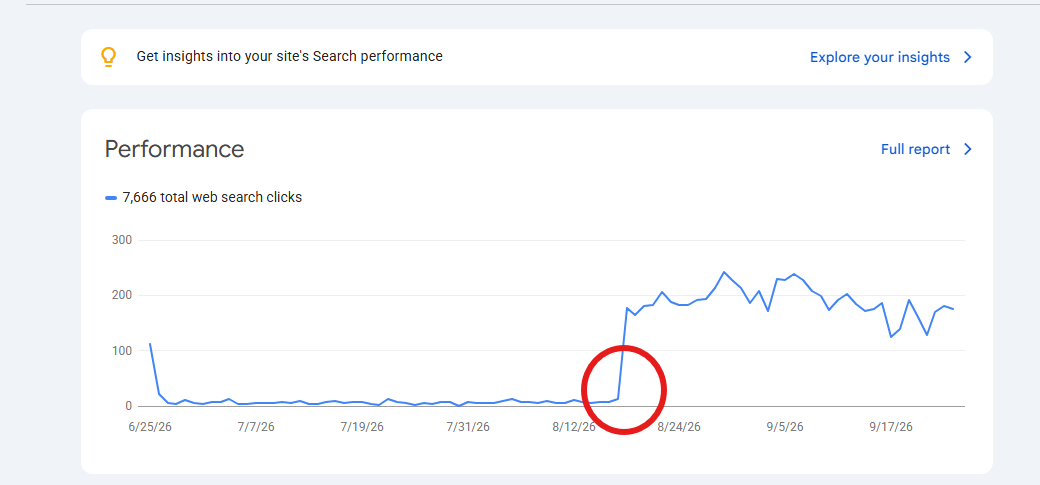
Open Google Search Console and compare the website's clicks and impressions before and after the decline. Check the pages that bring in customers, especially those targeting your main services and locations.
If a page has disappeared from Google, check whether it is still accessible and indexed. If you changed its URL, make sure the old address redirects correctly where appropriate.
Your website should explain what you do, where you work and how customers can contact you.
A roofing company might have useful pages for roof repairs, roof replacement and flat roofing. A blinds business could explain its made-to-measure options, fitting service and available products. A locksmith might cover lock replacements, emergency call-outs and commercial work if those are services it provides.
Each page should give customers information they can use. There is little value in publishing dozens of town pages that repeat the same text with only the location changed.
If your profile needs attention as well, you can read more about our Google Business Profile optimisation service.
7. Check Your Business Details Across the Web
If you have moved premises, changed your business name or switched telephone numbers, check that your details are correct across the main places where customers find you.
Start with your website, Google Business Profile and the business directories you actively use. Look for old addresses, disconnected phone numbers, outdated website links and duplicate listings.
For example, a locksmith who has changed telephone numbers may still have the old number listed on several directories. A roofing company that has moved premises might have an outdated address on an old business listing.
Correct those genuine errors first.
You do not need to spend a whole day checking every directory on the internet. Focus on important listings and places where you know the information is wrong.
Consistent details are useful for customers, but one minor difference in formatting does not automatically explain a sudden ranking decline.
8. Keep Asking Customers for Honest Reviews
Reviews help people decide whether to contact your business. They also contribute to Google's understanding of local prominence, although they do not guarantee higher rankings.
If you have stopped receiving reviews, make it easy for customers to leave honest feedback after a job has been completed.
A roofer could send a short thank-you message after finishing a repair. A blinds installer could invite a customer to share their experience after fitting. A locksmith could do the same after a lock replacement.
Keep the request simple and give customers the choice to respond.
Do not pay for positive reviews, offer discounts in exchange for reviews, or ask only customers you expect to be happy to leave feedback. Google prohibits practices that manipulate reviews.
If someone leaves a negative review, respond politely and try to resolve the issue. Avoid arguing publicly or sharing private details about the customer.
I would not buy reviews to try to recover rankings. It is not a sensible way to build a reliable reputation.
9. Understand Why Google Maps Rankings Change
Google identifies three main factors in local search rankings: relevance, distance and prominence.
Relevance is how well your business matches what someone is looking for.
Distance is how far your business is from the person searching, or from the location used in the search.
Prominence relates to how well-known your business is. Reviews and information about your business across the web can contribute to this.
These factors help explain why a business might appear near the top for one search but much lower for another.
You can improve the accuracy of your profile, make your services clearer, maintain useful website pages and build a genuine reputation. You cannot control where every customer is searching from, and no single change guarantees a particular position.
Google also states that businesses cannot pay for better local rankings.
Be wary of anyone promising to put your business in the top three across an entire city within a few days. Ask what they have found, what work they propose and how they will measure the results.
You can read Google's own guidance on improving your local ranking.
10. What Not to Do When Your Rankings Drop
When the phone stops ringing, it is easy to start changing everything. I would resist that temptation until I had a clearer picture of the problem.
Here are the things I would avoid.
- Do not keep changing your business name. It should reflect your real-world business name, not a list of keywords and locations.
- Do not switch categories every few days. Check that the category is accurate and make a considered correction only if necessary.
- Do not delete your profile and start again. Investigate the existing listing first.
- Do not create duplicate listings. They can confuse customers and complicate profile management.
- Do not buy reviews. Build your reputation through genuine customer feedback.
- Do not blame competitors without evidence. A lower ranking does not prove that someone has done anything wrong.
- Do not pay for random SEO fixes. Find out what needs fixing before committing to work.
- Do not ignore your website. Your service pages may have lost traffic even if the profile itself is healthy.
I would also stop checking the rankings every hour. Record the affected searches, make changes only when there is a reason to do so, and compare the results over time.
A Seven-Day Plan to Investigate the Drop
If you are not sure where to start, I would work through the following checks over a week.
Day 1: Check the profile
Confirm that the listing is active and look for verification requests, suspension notices or rejected edits.
Day 2: Record your rankings
Choose your main services and locations. Record where the business appears for those searches, using comparable locations for future checks.
Day 3: Review recent changes
Check the business name, category, address, service area, telephone number and website. Note anything that changed before the decline.
Day 4: Check the data
Compare your Google Business Profile performance with the previous period. Use Google Search Console to check whether important website pages have lost clicks or impressions.
Day 5: Look at competitors
Compare the businesses appearing above you. Check their service relevance, profile information, reviews and websites.
Day 6: Fix confirmed problems
Correct inaccurate information, address website errors and follow Google's guidance if there is a profile restriction. Avoid unrelated changes.
Day 7: Record what you found
Keep a note of the original problem, the changes made and the results so far. Continue monitoring the same searches and customer enquiries over the following weeks.
This plan gives you a sensible way to investigate the problem. It does not mean your rankings will return in seven days. Straightforward errors may be resolved quickly, while other issues take longer to investigate.
When Is It Worth Getting Professional Help?
If your profile is active and the problem is a minor error, you may be able to sort it out yourself.
I would consider a professional audit if the listing has disappeared, a suspension is involved, rankings have fallen across several locations, or website traffic and enquiries have dropped at the same time.
The first step should be to find out what is wrong, not to sell you a complete rebuild without examining the evidence.
At Prime Local SEO, we work with UK businesses that depend on local enquiries. That includes trades and home-service businesses where appearing in the right local searches can make a real difference to the working week.
Our Google Business Profile optimisation service is a starting point if you need help with your profile and local visibility. You can also visit Prime Local SEO to enquire about a local SEO audit.
The aim is to identify the problem, deal with the issues that matter and avoid spending money on changes that are unlikely to help.
Frequently Asked Questions
Why has my Google Business Profile suddenly dropped in rankings?
I would check the profile's status, recent edits, website performance and local competitors first. The decline could be related to a profile issue, changing competition, search location or a drop in customer demand. The timing and performance data help narrow down the possibilities.
How long does it take to recover Google Maps rankings?
There is no fixed recovery time. Correcting an inaccurate detail may be straightforward, while a suspension, website problem or decline in a competitive area can take longer. I would monitor the same searches and locations rather than rely on a promised deadline.
Should I change my Google Business Profile category after a ranking drop?
Only if the current category does not accurately describe the business. I would check the main service the business provides and make sure the category reflects it. If it is already correct, I would investigate other causes before changing it.
Can changing my business name affect Google Maps rankings?
It can affect how your business information is reviewed or displayed. Your profile name should match the real-world name of the business. Adding towns or service keywords purely to influence rankings can breach Google's guidelines.
Why does my business appear by name but not for my services?
Your profile can appear for branded searches without ranking prominently for service searches. I would check the relevance of the profile, the searcher's location, competing businesses and the website pages covering those services.
Can my website cause my Google Business Profile rankings to drop?
Website problems can affect your wider local search presence. If important service pages have been removed, URLs have changed or pages are no longer indexed, I would investigate those issues. I would still check the profile separately rather than assume the website explains everything.
Should I delete my Google Business Profile and create a new one?
I would not do this simply because rankings have fallen. Check whether the existing listing is active, verified or suspended, and investigate any errors before considering major changes. Creating a duplicate can cause additional problems.
Can negative reviews cause a sudden ranking drop?
I would not assume that one negative review caused the decline. Reviews contribute to prominence, but local rankings depend on several factors. Check for other changes around the same time and respond professionally to genuine customer concerns.
Does posting regularly help recover Google Maps rankings?
Posts can keep customers informed about services, availability and business updates. However, posting more frequently is not a guaranteed way to recover rankings. I would first check the profile's status, accuracy and performance.
Why has my roofing or locksmith business disappeared from Google Maps?
Start by searching for the exact business name and checking the profile's status. Look for suspension notices, verification requests or significant edits. If the listing is active, check the main service searches across several locations to see whether the problem is a ranking decline rather than a missing profile.
Can competitors make my Google Business Profile rank lower?
Competitors can improve their own visibility, changing which businesses appear above yours. Compare their services, categories, reviews and websites with your own. A drop in rankings does not, by itself, show that a competitor has done anything wrong.
What should I do first if my Google Business Profile suddenly drops?
I would confirm that the profile is active, record which searches and locations have been affected, and review recent changes to the profile and website. Correct any confirmed problems before making other changes.
When should I contact a local SEO specialist?
Consider an audit if the profile has disappeared, a suspension is involved, rankings have fallen across several service areas or the cause remains unclear. The audit should examine the profile, website, local competitors and available performance data before recommending a course of action.
Can Prime Local SEO help investigate a sudden ranking drop?
Prime Local SEO works with UK businesses looking to improve their local search presence. You can find out more about our Google Business Profile optimisation service or visit our website to enquire about an audit.
Final Thoughts
If your Google Business Profile has dropped, do not assume you have lost your rankings permanently. Start by checking that the listing is active, find out which searches have been affected and look at what changed before the decline.
If the information is correct, check your performance data, website and local competitors before making further edits.
For a roofer, locksmith or blinds installer, the priority is getting back in front of the right customers. That starts with finding out what has gone wrong rather than changing everything in the hope that something works.
If you cannot identify the cause, an evidence-based local SEO audit can help you decide what needs attention and what can safely be left alone.
Need help investigating a drop in local visibility? Visit Prime Local SEO to discuss your business and the searches that have stopped bringing in enquiries.
Want results like this for your own business?
Get a free, no-obligation Local SEO audit for your website.
Get Free Local Audit