Google Core Update Recovery: How We Helped a UK Roofing Company Recover Its Search Traffic
Published 27 September 2026
A real SEO recovery case study from a UK roofing website
When a website suddenly loses most of its Google traffic, the first reaction is often:
"Google has penalised us. We need more backlinks."
That wasn't the answer for one of our recent UK roofing clients.
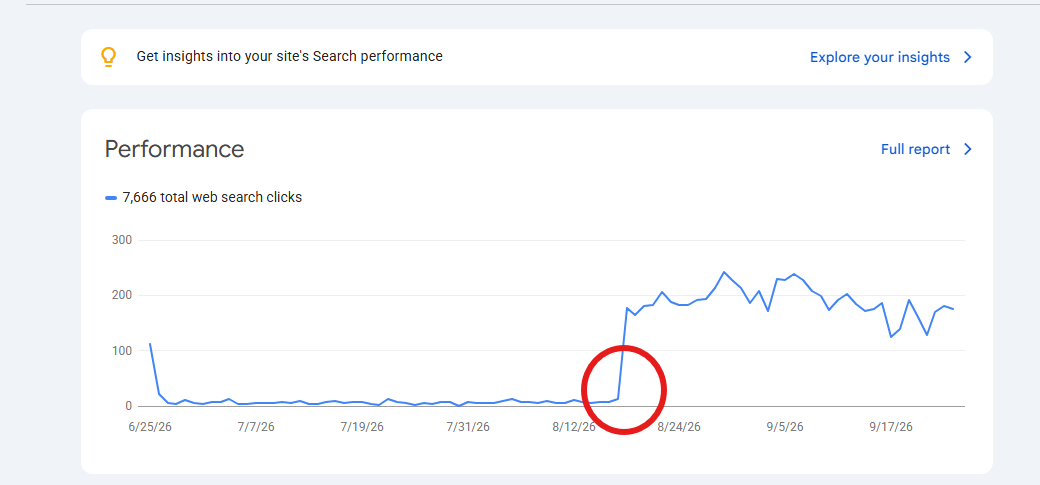
The website had experienced a major drop in organic search visibility following a Google Core Update. Looking at Google Search Console, the decline was clear. Search traffic had fallen from a healthy level to almost nothing.
The client contacted us to find out what had gone wrong and whether the website could be recovered.
We started by looking at the website itself rather than immediately building new links.
The Problem Was Deeper Than a Google Update
We carried out a detailed SEO audit covering the website, Google Search Console, technical SEO, links, keywords, structured data, content and the previous SEO work.
What we found was concerning.
Cheap SEO Tactics Had Been Used
The website showed signs of previous SEO work that appeared to focus more on manipulating rankings than building a strong, useful website.
There were questionable links and SEO elements that had little connection with the actual roofing business.
Hidden Links Were Found
We discovered hidden links pointing towards casino-related content.
For a legitimate UK roofing company, these links had no useful connection with the business or its customers.
This was one of the first things that needed to be addressed.
The Website Was Targeting the Wrong Keywords
Some of the existing SEO work was focused on keywords that didn't properly match the company's services, locations or customer search intent.
Ranking for the wrong searches doesn't necessarily bring more customers.
For a roofing company, SEO needs to focus on the services people actually need, the areas the company serves and the problems potential customers are trying to solve.
The Schema Wasn't Correctly Implemented
The website also had issues with its structured data.
The wrong business entity was being used, and there were problems with rating-related markup that needed to be reviewed.
Schema isn't a shortcut to rankings.
It needs to accurately represent the business and the information displayed on the website.
We Didn't Just Build More Backlinks
This is where we took a different approach.
Instead of immediately adding more backlinks or publishing dozens of new articles, we created a recovery plan and started fixing the existing problems.
The work included:
- Cleaning up problematic SEO elements
- Reviewing the website's backlink profile
- Identifying irrelevant and suspicious links
- Correcting keyword targeting
- Fixing the structured data
- Reviewing business information
- Checking technical SEO
- Reviewing internal linking
- Improving page relevance
- Checking indexed pages
- Reviewing the overall SEO structure
The goal wasn't simply to make the website look better.
The goal was to remove the problems that were holding it back.
Then We Let Google Reassess the Website
SEO recovery doesn't happen overnight.
After making the changes, we monitored the website through Google Search Console and tracked its organic performance.
Over time, the website recovered.
The site returned to the level of performance it had reached before the previous Core Update.
Even more importantly, when another Core Update came around, the website survived it without experiencing the same collapse.
That was the result we wanted.
We didn't want to temporarily push the numbers back up.
We wanted to fix the underlying problems.
The Important Lesson for UK Businesses
If your website loses traffic after a Google Core Update, don't immediately assume that you need hundreds of new backlinks or dozens of new blog posts.
Start by finding out why the traffic dropped.
Look at:
- Which pages lost traffic
- Which keywords disappeared
- What changed in Search Console
- Your technical SEO
- Your backlink profile
- Your internal links
- Your content
- Your keyword targeting
- Your structured data
- Previous SEO work
A website can look completely normal to a business owner while carrying years of poor SEO work underneath.
And sometimes the problem isn't what you need to add.
It's what needs to be removed.
You Don't Always Need a Long SEO Contract to Fix a Problem
One interesting part of this project was the contract.
We didn't put the client into a 6-month or 12-month contract just to clean up the problems.
The initial recovery work was completed in one month.
That doesn't mean every SEO campaign should last one month.
Businesses that want to continually increase organic traffic, generate leads and compete in local search will normally need ongoing SEO.
But SEO recovery and long-term SEO growth are two different things.
If your website has been damaged by poor SEO, the first step should be finding and fixing the problem.
After that, you can decide what ongoing SEO work actually makes sense for your business.
Has Your Google Traffic Suddenly Dropped?
If you're a UK business owner and your website has lost rankings or organic traffic after a Google update, don't start spending money on more SEO without understanding what happened first.
At Prime Local SEO, we can audit your website, Search Console data and existing SEO setup to identify the issues that may be affecting your visibility.
Find the problem first. Fix it properly. Then build from a clean foundation.
Want results like this for your own business?
Get a free, no-obligation Local SEO audit for your website.
Get Free Local Audit